Foundations · 2 min read · 22 Oct 2026
Residues Are the Letters Peptides Are Spelled With
A peptide is spelled, not drawn: twenty letters, one per residue. Learn the alphabet and most of the jargon stops being scary.
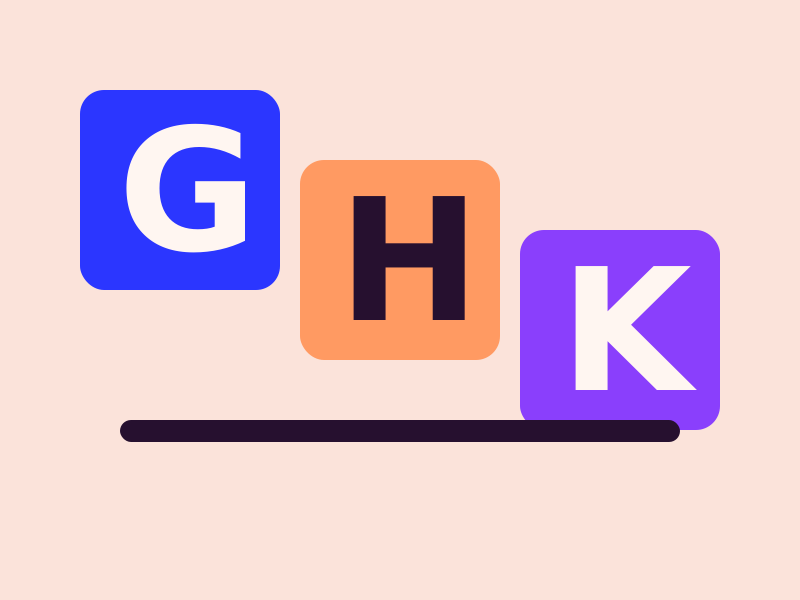
A chain is a sentence
When biochemists describe a peptide they do not draw every atom. They write a string of letters, one for each residue, which is what an amino acid is called once it has been built into a chain. Glycine is G, alanine is A, tryptophan is W. The string reads from the N-terminus (the free amine end) to the C-terminus (the free acid end).
A tiny example: GHK is glycine, histidine, lysine. Three residues, three letters.
Why order matters
The same three residues in a different order are a different molecule, with different shape, charge distribution and behaviour. KHG is not GHK. Biology is picky about sequence in the same way a lock is picky about a key.
Four families of residues
| Family | What they do | Examples |
|---|---|---|
| Charged | Attract water and partners of opposite charge | K, R, D, E |
| Polar | Form hydrogen bonds | S, T, N, Q |
| Greasy (hydrophobic) | Hide from water, cluster together | L, I, V, F |
| Special | Bend, kink or bridge the chain | G, P, C |
Reading a sequence is mostly asking one question: which residues like water, and which run from it?
Beyond the twenty
Real peptide drugs often step outside the standard alphabet. Chemists add D-forms (mirror images), N-methyl groups or entirely synthetic residues to slow down the enzymes that cut chains apart. When a label lists a sequence with odd symbols, that is usually the reason.
What to take away
- A peptide's identity is its sequence, written N to C.
- Residue properties explain more behaviour than the length does.
- If a product page never states the sequence, you cannot know what it is.
Sources
- IUPAC-IUB JCBN, Nomenclature of Amino Acids and Peptides, 3AA-11 and 3AA-12 (peptides and amino-acid residues): https://iupac.qmul.ac.uk/AminoAcid/A1113.html
- IUPAC-IUB JCBN, Nomenclature of Amino Acids and Peptides, 3AA-21 (the one-letter system): https://iupac.qmul.ac.uk/AminoAcid/A2021.html
- PubMed, PMID 16622600 (Werle and Bernkop-Schnürch, Amino Acids 2006, strategies to extend peptide half-life): https://pubmed.ncbi.nlm.nih.gov/16622600/
Along the table
 Next element · 29 BdThe Peptide Bond Is Flatter Than You ThinkThe link between two residues is not a free hinge. It is rigid and planar, and that one fact shapes every fold in biology.
 Previous element · 27 Aq5 Amino 1MQ Dosage Facts From Mouse Studies and Why No Human Protocol Exists5 Amino 1MQ is a ring shaped enzyme blocker, not a peptide. See what the mouse studies measured and why no human dose exists.
Same family
08En Peptides for Energy and What the Evidence Says About FatigueEnergy means ATP in biochemistry and vigour in marketing. See what SS 31 and MOTS c research shows and where the fatigue evidence stops. 06Sa SARMs vs Peptides Read Through Their Chemical BlueprintsSARMs are small ring based molecules and peptides are residue chains. Compare structure, delivery, legal status and product quality.