Foundations · 2 min read · 22 Oct 2026
The Peptide Bond Is Flatter Than You Think
The link between two residues is not a free hinge. It is rigid and planar, and that one fact shapes every fold in biology.
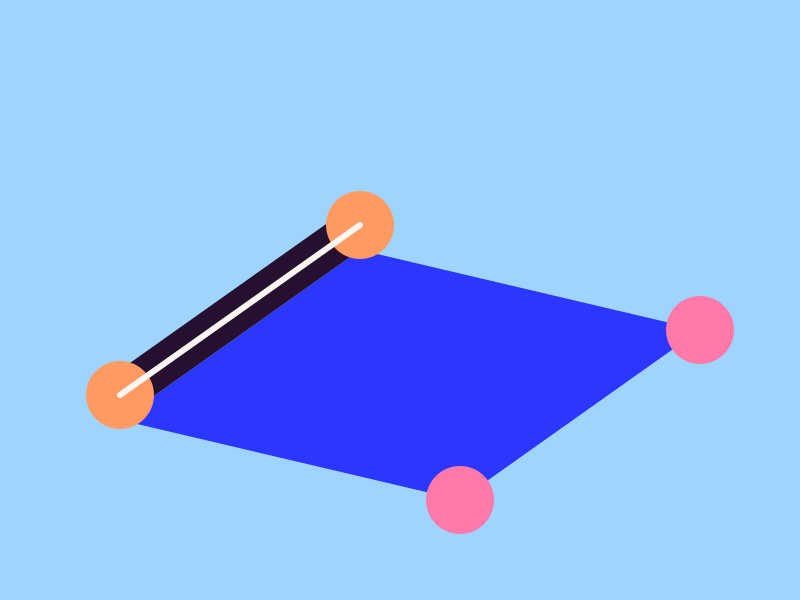
A bond with partial double bond character
Chemistry diagrams draw the peptide bond as a single line. In reality the electrons around the carbon-nitrogen link are shared in a way that makes it behave partly like a double bond. It cannot spin freely: the twist across it stays near 180 or 0 degrees, and 180, the trans form, is the usual one. The six atoms around it lock into one flat plane.
Where the flexibility lives
If the bond itself is rigid, the chain can only bend at the two neighbouring joints on either side of each residue. Those two rotation angles are called phi and psi. Map every pair of values and most angle combinations clash atoms together, a result first worked out in 1963. Real structures crowd into the few regions that are left.
Why this matters for folding
Because every residue offers just two dials and each dial has few allowed settings, chains fall into repeating patterns:
- Alpha helices: a spiral stabilised by hydrogen bonds between residues four apart.
- Beta strands: nearly straight segments that pair side by side.
- Turns and loops: short bends that reverse direction.
The odd one out
Proline's side chain loops back onto its own nitrogen, which makes it a natural kink-maker. Glycine has no side chain at all, so it is the most flexible. Pairing them is a classic way nature builds a sharp turn.
Takeaway
Short peptides are flexible because they have few constraints to stack. Long chains find a stable fold because the rigid planes and limited angles guide them there.
Sources
- IUPAC-IUB CBN, Conformation of Polypeptide Chains, section 3 (torsion angles phi, psi and omega): https://iupac.qmul.ac.uk/misc/ppep3.html
- PubMed, PMID 13990617 (Ramachandran, Ramakrishnan and Sasisekharan, J Mol Biol 1963, stereochemistry of polypeptide chains): https://pubmed.ncbi.nlm.nih.gov/13990617/
- PubMed Central, PMC1063337 (Pauling, Corey and Branson, PNAS 1951, hydrogen-bonded helical configurations): https://pmc.ncbi.nlm.nih.gov/articles/PMC1063337/
Along the table
 Next element · 30 GtHow a Gut Peptide Tells Your Brain You Are FullAfter a meal, cells in the intestine release short peptides that travel by blood and nerve. The message is simple: slow down.
 Previous element · 28 RsResidues Are the Letters Peptides Are Spelled WithA peptide is spelled, not drawn: twenty letters, one per residue. Learn the alphabet and most of the jargon stops being scary.
Same family
08En Peptides for Energy and What the Evidence Says About FatigueEnergy means ATP in biochemistry and vigour in marketing. See what SS 31 and MOTS c research shows and where the fatigue evidence stops. 06Sa SARMs vs Peptides Read Through Their Chemical BlueprintsSARMs are small ring based molecules and peptides are residue chains. Compare structure, delivery, legal status and product quality.